Force Review
- Know what causes each force type: weight, tension, normal, friction.
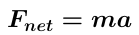
- Sum all forces to find net force, and know that the object accelerates if Fnet ≠ 0
- Know the rules that determine the strength of various forces
- Recognize that all forces exist in pairs acting on different objects.
- I push a crate with a net force of 40 N, and it accelerates at a rate of 8 m/s². What is its mass?
b) What would the acceleration of the crate have been if the mass were 10 kg?
c) How much force would it take to accelerate that (10 kg) crate at 2 m/s²?
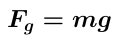
- a) What is the weight of a box that has a mass of 30 kg?
b) What is the mass of a box that has a weight of 30 N?
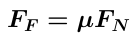
- I am pushing a table (weight = 100N) across the floor. This requires a force of 40 N when I am on the rug, but only 10 N when I am on tile floor. Why?
b) If my brother (mass = 60 kg) sits on top of the table, how much force will now be needed on the rug? On the floor?
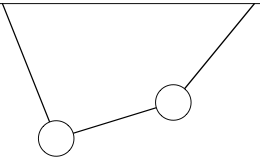
- a) Sketch a free body diagram for each ball in the situation shown to the right. Be careful to make all the force arrows roughly the right length.
b) Which ball is heavier?
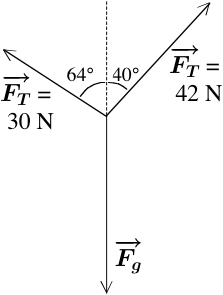
- There are two tension forces acting on this object, as shown in the picture.
a) Find the vector form of each tension force.
b) What is the weight?
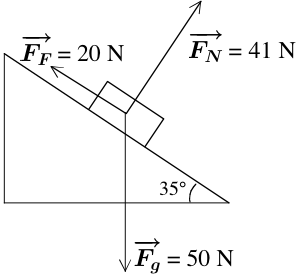
- A box is on a ramp as shown to the right.
a) Find the vector form of each force
(Hint: any triangle you draw will have the same angles as the ramp - figure out which is which based on whether they are large or small angles)
b) Find the net force
c) Find the mass
d) Find the acceleration